Building a Visual Reasoning Engine for Indian Traffic
How we designed a five-level reasoning pipeline that goes from pixel-level detection to predictive intelligence — and why Indian roads are the ultimate proving ground.
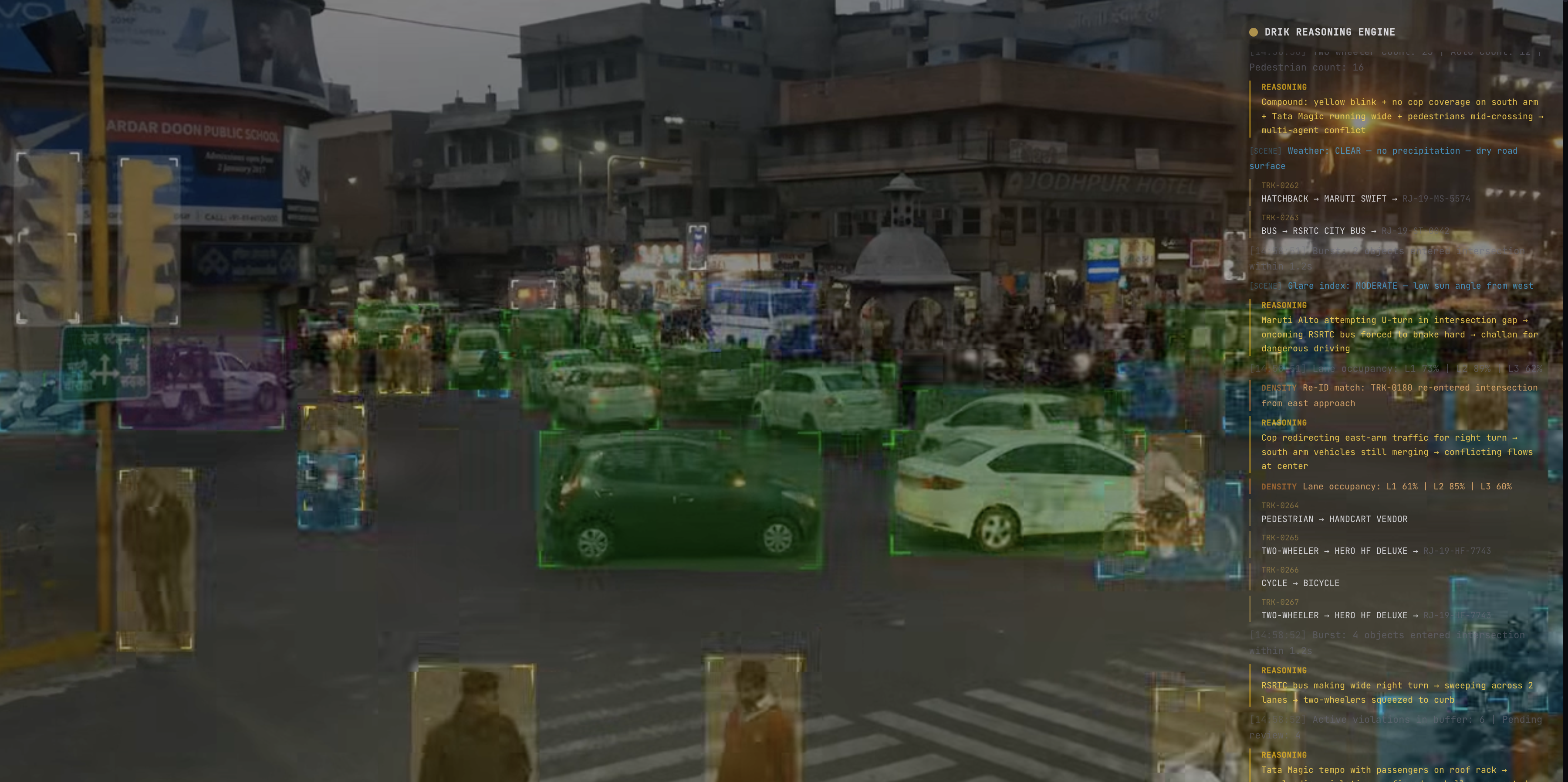
The Problem
Every camera on every Indian road captures chaos. Auto-rickshaws weaving through traffic, overloaded trucks ignoring lanes, pedestrians crossing at will. Standard computer vision models trained on Western traffic datasets fail catastrophically here.
We didn’t want to build another object detector. We wanted to build something that understands what it sees.
Five Levels of Visual Reasoning
Our architecture is built around a five-level reasoning hierarchy:
- Detect — See every object in every frame
- Recognize — Read plates, identify makes and models
- Describe — Generate natural language scene descriptions
- Reason — Understand cause and effect
- Predict — Anticipate what happens next
Each level builds on the one below it. You can’t reason about a scene if you can’t describe it. You can’t describe it if you can’t recognize what’s in it.
Why Indian Traffic?
We chose the hardest visual environment on earth deliberately. If our system works on Indian roads — with 50+ vehicle types, no lane discipline, mixed traffic, and unpredictable behavior — it works everywhere.
The diversity of Indian traffic is a feature, not a bug. It forces our models to generalize in ways that controlled environments never could.
The Edge-First Architecture
Every millisecond matters when you’re processing live camera feeds. Our architecture processes video at the edge — no cloud round-trip required.
- Ingestion: RTSP/ONVIF streams decoded on-device
- Detection: TensorRT-optimized inference at 30+ FPS
- Tracking: Persistent identity across occlusions
- Recognition: Multi-frame plate super-resolution
- Reasoning: Scene understanding and violation detection
The entire pipeline runs under 100ms end-to-end.
What’s Next
We’ve crossed Level 3 — our system can now describe what it sees in natural language. Level 4 (causal reasoning) is in active development, and Level 5 (prediction) is on the horizon.
Follow our progress on the Technology page or check out our open source tools to see the building blocks.